Dryer Belt Replacement: Complete DIY Guide & Signs of a Broken Belt
A broken dryer belt is one of the most common dryer problems - and fortunately, one of the easiest to fix yourself. This comprehensive guide walks you through identifying a broken belt, finding the right replacement part, and completing the repair step by step.
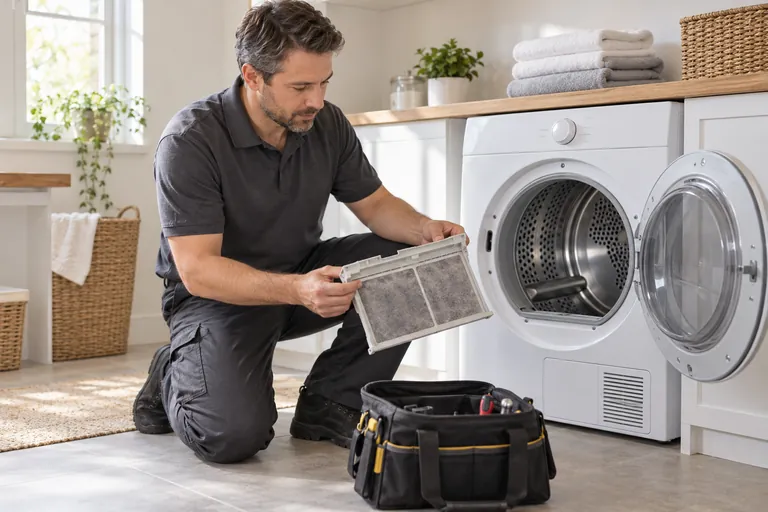
When your dryer stops spinning, a broken belt is often the culprit. The dryer belt is a thin rubber band that wraps around the drum and connects to the motor through a pulley system. When it breaks, the motor runs but the drum doesn't turn, leaving your clothes wet and your laundry routine disrupted.
The good news? Replacing a dryer belt is a manageable DIY project for most homeowners. With basic tools and about 30-45 minutes of time, you can save $150-200 in professional repair costs. This guide covers everything from diagnosis to completion.
How Dryer Belts Work
Understanding your dryer's belt system helps with both diagnosis and repair. Here's how the components work together:
The Belt System Components
- Dryer Belt: A thin, flat rubber belt (typically 3/8" to 1/2" wide and 80-90" long) that wraps around the drum
- Motor Pulley: A small wheel on the motor shaft that drives the belt
- Idler Pulley: A spring-loaded pulley that maintains proper belt tension
- Drum: The large cylinder that holds your clothes
The motor turns the motor pulley, which pulls the belt. The belt wraps around the entire drum circumference, causing the drum to rotate. The idler pulley creates tension to keep the belt tight and prevent slipping.
Pro Tip
When replacing your belt, it's wise to also inspect the idler pulley and motor pulley. Worn pulleys can damage a new belt quickly, turning one repair into repeated failures.
Signs Your Dryer Belt Is Broken
Before ordering parts or taking anything apart, confirm that the belt is actually the problem. Here are the telltale signs:
Definitive Signs of a Broken Belt
| Symptom | What You'll Notice | Certainty |
|---|---|---|
| Motor runs, drum doesn't | Humming sound, no tumbling | Very High |
| Drum spins freely by hand | No resistance when you turn it | Very High |
| Belt pieces visible | Rubber fragments in or around dryer | Definite |
| Thumping before failure | Was making thumping sounds | High |
How to Test for a Broken Belt
- Start the dryer: Press start and listen carefully
- Listen for the motor: You should hear a humming sound
- Check for tumbling: Open the door - the drum should be stationary
- Try spinning the drum: With the dryer off, spin the drum by hand. If it spins very easily with no resistance, the belt is broken
Similar Symptoms, Different Problems
A drum that won't spin could also indicate a broken idler pulley, seized drum rollers, or a motor problem. If the drum is hard to turn by hand, the issue is likely drum rollers or bearings, not the belt.
Signs Your Belt Is Wearing Out (But Not Broken Yet)
- Squealing noise: High-pitched squeal during operation
- Thumping sound: Regular thump as the drum rotates
- Burning rubber smell: Belt slipping on pulleys
- Longer dry times: Belt slipping = slower drum speed
Finding the Right Replacement Belt
Dryer belts are not universal - you need the exact belt for your model. Here's how to find it:
Locating Your Model Number
The model number is typically found:
- Inside the door frame or door
- On the back of the dryer
- On a label inside the front panel
- In your owner's manual
Belt Specifications by Brand
| Brand | Common Belt Type | Typical Length | Price Range (CAD) |
|---|---|---|---|
| Whirlpool/Maytag/Kenmore | 4-rib multi-rib | 92.5" | $15-25 |
| Samsung | 4-rib multi-rib | 91.5" | $20-35 |
| LG | 4-rib multi-rib | 91.5" | $20-35 |
| GE/Hotpoint | Flat or multi-rib | 89" | $15-30 |
| Frigidaire/Electrolux | Flat belt | Various | $20-40 |
Where to Buy Dryer Belts
- Online Parts Retailers: PartSelect, RepairClinic, Amazon
- Local Appliance Parts Stores: Reliable Parts, AM-RAD, Marcone
- Big Box Stores: Home Depot, Lowe's (limited selection)
- Manufacturer Direct: Samsung, LG, Whirlpool parts websites
Pro Tip
Order from an appliance parts store rather than generic Amazon sellers. OEM or quality aftermarket parts last much longer than cheap knockoffs. The $5 savings isn't worth repeating this repair in a year.
Tools and Materials Needed
Gather these before starting the repair:
Required Tools
- Putty knife or flat screwdriver (for releasing clips)
- Nut driver set (1/4" and 5/16" most common)
- Phillips screwdriver
- Flashlight
- Work gloves
- Smartphone (to take photos before disassembly)
Materials
- Replacement dryer belt (model-specific)
- Optional: New idler pulley (recommended if original is worn)
- Optional: Drum roller kit (if rollers are worn)
Step-by-Step Belt Replacement
These instructions cover most standard dryers. Your model may vary slightly.
Safety First
Always unplug the dryer or turn off the circuit breaker before beginning. For gas dryers, also turn off the gas supply valve. Never work on a dryer that's connected to power.
Step 1: Disconnect Power and Access
- Unplug the dryer from the wall outlet
- For gas dryers, turn off the gas valve
- Pull the dryer away from the wall for access
- Remove the lint filter
Step 2: Remove the Top Panel
- Locate the clips holding the top panel (usually at the front corners)
- Insert a putty knife between the top and front panels
- Push in to release the spring clips
- Lift the top panel and prop it up or lean it against the wall
Step 3: Remove the Front Panel
- Disconnect the door switch wiring harness (take a photo first)
- Remove the screws holding the front panel (usually 2-4 screws at top)
- Some models have screws at the bottom as well
- Lift the front panel slightly and pull toward you
- Set the front panel aside
Step 4: Remove the Broken Belt
- Take a photo of the belt routing for reference
- Reach under the drum and locate the idler pulley
- Push the idler pulley toward the motor to release tension
- Slip the belt off the idler and motor pulleys
- Remove the old belt from around the drum
- Inspect the old belt - note how it was installed
Step 5: Inspect Other Components
While you have access, check these components:
- Idler Pulley: Spin it by hand - should turn smoothly and quietly
- Motor Pulley: Check for cracks or wear
- Drum Rollers: Spin them - should rotate freely
- Drum Glides: Check the felt pads at the front of the drum
Pro Tip
If the idler pulley doesn't spin freely or makes noise, replace it now. It's much easier to replace while the dryer is apart than to do this job twice.
Step 6: Install the New Belt
- Loop the new belt around the drum with the grooved/ribbed side against the drum
- Position the belt in the center of the drum
- Reach under the drum and thread the belt through the idler pulley
- Push the idler toward the motor to create slack
- Loop the belt around the motor pulley
- Release the idler - spring tension should tighten the belt
Step 7: Reassemble the Dryer
- Spin the drum by hand to verify the belt is tracking correctly
- Reinstall the front panel and secure with screws
- Reconnect the door switch wiring
- Lower and snap the top panel into place
- Reinstall the lint filter
- Push the dryer back into position
Step 8: Test the Repair
- Plug in the dryer (and turn on gas if applicable)
- Run the dryer empty for 5 minutes
- Listen for any unusual sounds
- Check that the drum is spinning smoothly
- Test with a small load of clothes
Brand-Specific Tips
Whirlpool, Maytag, Kenmore
These brands share similar designs and are generally the easiest to work on:
- Top panel releases with two spring clips at front
- Front panel lifts off after removing screws at top
- Belt routing: around drum, under idler, around motor pulley
- Watch for the drum support rollers when removing front panel
Samsung
- May have screws at the back of the top panel
- Front panel may have clips instead of screws at bottom
- Moisture sensor wires at front may need disconnecting
- Belt routing similar to Whirlpool
LG
- Often requires removing the back panel instead of front
- Some models have an access panel on the back for belt replacement
- Multi-rib belt with specific orientation
- Consult model-specific videos for your unit
GE/Hotpoint
- Older models may use a flat belt instead of multi-rib
- Front panel removal is similar to Whirlpool
- Some models have a front access panel for easier belt access
Troubleshooting After Replacement
Belt Keeps Coming Off
- Belt may be wrong length for your model
- Idler pulley may be worn or positioned incorrectly
- Belt may not be centered on drum
- Drum may not be seated properly in rollers
Squealing After Installation
- New belt may need to break in (usually stops after few cycles)
- Belt may be too tight - check idler spring
- Idler pulley may be worn
- Belt may be installed inside-out (grooves facing wrong way)
Drum Still Won't Turn
- Belt may not be around motor pulley correctly
- Idler pulley may not be tensioning properly
- Motor may have separate issue
- Drum may be jammed (check for foreign objects)
When to Call a Professional
While belt replacement is DIY-friendly, some situations call for professional help:
- Gas dryer concerns: If you're uncomfortable with gas appliances
- Motor problems: If motor doesn't run at all or runs intermittently
- Bearing replacement: Drum bearings require extensive disassembly
- Multiple worn parts: If rollers, idler, and belt all need replacement
- Electrical issues: If you encounter wiring problems
- Repeated belt failures: Indicates underlying problem
Expert Dryer Repair in Toronto
Our technicians carry common dryer parts on their trucks for same-day repair. All brands serviced with warranty on parts and labor.
Call (437) 524-1053DIY vs. Professional Cost Comparison
| Approach | Parts Cost | Labor Cost | Total |
|---|---|---|---|
| DIY - Belt Only | $15-35 | $0 | $15-35 |
| DIY - Belt + Idler | $30-60 | $0 | $30-60 |
| Professional - Belt Only | $20-40 | $100-150 | $120-190 |
| Professional - Full Service | $40-80 | $100-150 | $140-230 |
Preventing Future Belt Failures
Make your new belt last as long as possible:
- Don't overload: Excessive weight strains the belt
- Clean the lint filter: Every single load
- Clean the vent system: Annually to reduce drying time
- Level the dryer: Vibration from an unlevel dryer strains components
- Remove foreign objects: Check pockets before drying
- Don't stop mid-cycle: Let the drum come to a natural stop
Frequently Asked Questions
How do I know if my dryer belt is broken?
The most obvious sign is that the motor runs (you hear humming) but the drum doesn't spin. If you open the door and can spin the drum very easily by hand with almost no resistance, the belt is broken. You might also find pieces of black rubber inside the dryer.
How long does a dryer belt last?
A dryer belt typically lasts 10-15 years under normal use. However, factors like overloading, running the dryer while unlevel, or having a restricted vent can shorten belt life. If you hear squealing or thumping sounds, your belt may be wearing out and due for replacement.
Can I run a dryer with a broken belt?
No, you should not run a dryer with a broken belt. The belt is essential for turning the drum - without it, clothes won't tumble and won't dry. Additionally, running the motor without a load could cause it to overheat. Replace the belt before using the dryer again.
Are all dryer belts the same?
No, dryer belts vary by brand and model. They differ in length (typically 84-93 inches), width, and type (flat vs. multi-rib). Always order a belt specific to your dryer's model number for proper fit and function.
How hard is it to replace a dryer belt?
Replacing a dryer belt is considered a moderate DIY project. It requires basic tools and typically takes 30-45 minutes. The most challenging part is threading the belt through the idler pulley system. Most homeowners with basic mechanical ability can complete this repair.
Should I replace the idler pulley when replacing the belt?
It's recommended if the idler pulley shows any signs of wear (wobbles, doesn't spin freely, or makes noise). Since you already have the dryer apart, replacing the $15-25 idler pulley now can prevent another breakdown soon. It's a common point of failure.
Why does my dryer squeal after I replaced the belt?
A slight squeal after belt replacement is normal and usually stops after a few drying cycles as the belt breaks in. If it persists, check that the belt is installed with the grooved side against the drum, the idler pulley spins freely, and the belt is properly tensioned.
How much should I pay for a dryer belt replacement?
If you DIY, expect to pay $15-40 for the belt. Professional repair typically costs $120-200 total, including parts and labor. For older dryers worth less than $300, DIY repair makes the most financial sense.
Conclusion
Replacing a dryer belt is one of the most accessible appliance repairs for DIYers. With basic tools, a replacement belt, and this guide, you can restore your dryer to working condition in under an hour and save over $100 in repair costs.
Remember the key steps: confirm the belt is the problem, order the correct replacement part for your model, take photos during disassembly, and inspect other components while you have access. If you encounter complications or prefer professional service, our technicians are always available to help.
Whether you tackle this repair yourself or call in the pros, getting your dryer running again doesn't have to be complicated or expensive. A broken dryer belt is inconvenient, but it's one of the simplest fixes in the appliance repair world.
