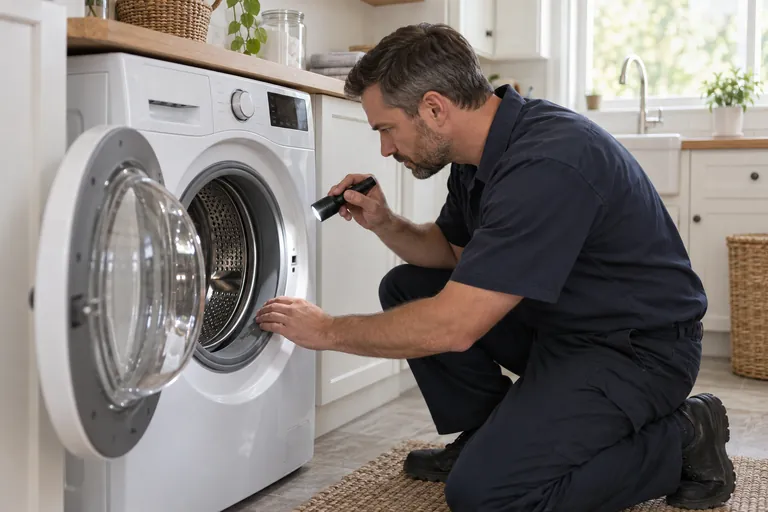

If your washer drum won't spin, the most common causes are a broken drive belt, faulty lid switch, worn motor coupling, or failed motor. Most repairs cost $150–$300 and take 1–2 hours. Don't put it off — wet laundry sitting in the drum can cause mould and secondary damage. For same-day Toronto service, call (437) 524-1053.
A washing machine drum that won't spin leaves you with soaking wet laundry and a household emergency. Whether your washer fills with water but refuses to agitate or spin, makes grinding noises during operation, or spins intermittently, understanding the drive system components—from belts and couplings to motors and transmissions—enables effective troubleshooting and informed repair decisions.
Understanding Washing Machine Drive Systems
Washing machines employ two primary drive configurations, each with distinct failure patterns and repair requirements:
Belt-Drive Systems (Common in Older Top-Loaders and Some Front-Loaders)
Belt-drive washers use a rubber V-belt or serpentine belt connecting the motor pulley to the transmission or drum pulley. The motor typically operates at 1,725 RPM (revolutions per minute), while the belt reduces this speed to appropriate agitation (60-80 RPM) and spin speeds (600-1,000 RPM for top-loaders, 1,000-1,400 RPM for front-loaders).
Advantages: Simple design, easy belt replacement, natural shock absorption from belt flexibility, and lower motor stress during startup.
Disadvantages: Belts wear over 7-10 years, requiring periodic replacement. Belt slippage reduces efficiency, and improper tension causes squealing or incomplete spinning.
Direct-Drive Systems (Common in Modern Top-Loaders)
Direct-drive washers eliminate the belt, connecting the motor directly to the transmission through a rubber coupling. This design, popularized by Whirlpool and used extensively in Kenmore and Maytag models, provides more efficient power transfer and quieter operation.
Advantages: Fewer moving parts, more reliable operation, better energy efficiency, and quieter performance.
Disadvantages: Couplings wear from repeated shock loads and fail every 5-8 years on average. Direct motor-to-transmission connection transfers more stress to transmission bearings.
Direct-Drive Motors (Common in Modern Front-Loaders)
High-efficiency front-loaders increasingly use direct-drive brushless DC motors mounted directly to the drum without belts, pulleys, or transmissions. These motors use electronic controls to provide variable speed from 0-1,400+ RPM.
Advantages: Extremely quiet operation, exceptional reliability (15-20 year motor lifespan), precise speed control, and maximum energy efficiency.
Disadvantages: Complex electronic controls, expensive motor replacement ($400-600), and specialized diagnostic equipment required for repairs.
Common Causes of Drum Rotation Failure
1. Broken or Worn Drive Belt
Drive belts represent the most common failure point in belt-drive washers, accounting for 40% of drum rotation problems. Modern belts use synthetic rubber compounds reinforced with kevlar or polyester cords, designed for 2,000-3,000 hours of operation.
Belt Failure Mechanisms:
- Glazing and Hardening: Heat exposure and age cause rubber to harden, reducing grip on pulleys. Glazed belts slip during high-torque operations like spin cycle startup.
- Cracking and Deterioration: Ozone exposure and temperature cycling create surface cracks that propagate through the belt structure, causing sudden failure.
- Stretching: Repeated stress elongates belts by 1-3% over years, reducing tension and causing slippage even when the belt remains intact.
- Abrupt Failure: Sudden loads from unbalanced loads or bearing seizure can snap belts instantly, leaving the motor running while the drum remains stationary.
Diagnostic Signs:
- Motor runs but drum doesn't rotate during any cycle
- Burning rubber smell preceding complete failure
- Squealing or chirping sounds during acceleration
- Drum rotates freely when manually pushed (no belt resistance)
- Visible belt pieces in the cabinet bottom or around the motor
Professional Replacement: Belt replacement typically costs $150-250 including labor. Technicians verify pulley alignment, check for bearing problems causing premature wear, and ensure proper belt tension. DIY belt replacement is feasible for mechanically inclined homeowners but requires accessing the washer's rear or bottom panel and navigating around suspension springs and electrical components.
2. Failed Motor Coupling
The motor coupling serves as the critical connection between motor and transmission in direct-drive top-load washers. This component consists of two plastic drive forks joined by rubber dampening elements designed to absorb shock loads and vibration.
Why Couplings Fail:
Couplings endure extreme stress during spin cycle startup, when the motor must accelerate a stationary drum filled with water-soaked laundry weighing 30-50 pounds. Each startup imposes torque loads reaching 200-300% of steady-state values. After 5-8 years of regular use (approximately 2,500-4,000 loads), rubber elements degrade and plastic forks crack or strip.
Accelerated Failure Factors:
- Consistent overloading beyond washer capacity ratings
- Unbalanced loads creating shock loads during spin distribution
- Transmission bearing wear increasing mechanical resistance
- Continuous use without allowing motor cooling between cycles
- Manufacturing defects in early production runs of specific models
Symptoms of Coupling Failure:
- Motor runs normally but drum remains stationary in all cycles
- Rattling or clunking sounds during agitation attempts
- White plastic shavings accumulating beneath the washer
- Intermittent operation where agitation works occasionally then fails
- Complete separation visible when transmission is accessed
Replacement Process: Coupling replacement requires removing the washer cabinet, drain pump, and motor to access the coupling between motor and transmission. Professional replacement costs $150-225 and takes 1-2 hours. While DIY replacement is possible, improper reassembly can damage the transmission seal, causing oil leaks requiring expensive transmission replacement.
3. Motor Problems
Washing machine motors fall into two categories: universal motors with carbon brushes (older top-loaders), and induction motors or brushless DC motors (front-loaders and modern top-loaders). Each type exhibits distinct failure patterns.
Universal Motor Failures (Brush Motors):
Universal motors use carbon brushes pressing against the motor's commutator to deliver electrical current to the rotating armature. These brushes wear gradually, eventually becoming too short to maintain proper contact. Brush lifespan typically ranges from 7-12 years depending on usage intensity.
Brush Motor Symptoms:
- Excessive sparking visible through motor ventilation slots
- Weak or intermittent motor operation
- Complete motor failure after years of declining performance
- Burning smell from carbon dust accumulation
- Motor runs briefly then stops, repeating this pattern
Brush replacement costs $100-175 and prevents $300-500 motor replacement when addressed before commutator damage occurs.
Induction Motor Failures:
Induction motors use capacitors to create rotating magnetic fields that drive the motor without brushes. These motors fail less frequently but problems include:
- Start Capacitor Failure: The motor hums loudly but doesn't start, or trips circuit breakers immediately. Replacement costs $100-150.
- Run Capacitor Failure: The motor starts slowly, runs weakly, or overheats. Replacement costs $75-125.
- Winding Failure: Motor won't run at all, or runs with burning smell. Requires complete motor replacement at $300-500.
4. Transmission Problems
The transmission (or gearcase) converts motor rotation into appropriate agitation and spin speeds while reversing direction for agitation cycles. Transmissions contain multiple gears, bearings, seals, and clutches operating in oil-filled housings.
Common Transmission Failures:
Mode Shifter Malfunction: The transmission mode shifter (actuator) switches between agitate and spin modes. Failure causes normal agitation but inability to shift into spin mode, leaving clothes soaking wet. Repair costs $200-350.
Clutch Assembly Wear: Top-loader clutches engage the basket during spin cycles. Worn clutches slip, preventing the basket from reaching full spin speed. Symptoms include slow spinning, burning smell, and excessive vibration. Clutch replacement costs $200-300.
Bearing Failure: Worn transmission bearings cause grinding noises, leaking oil seals, and eventual complete seizure. Bearing failure often occurs alongside other transmission damage, typically necessitating complete transmission replacement at $300-450 for parts plus $150-200 labor.
Seal Leaks: Failed transmission seals allow gear oil to leak onto belts or couplings, causing slippage and premature wear. Small leaks can be repaired ($100-150), but extensive leaks indicate internal bearing wear requiring transmission replacement.
5. Pulley Problems
Drive pulleys on the motor and transmission transfer power through the belt. Pulley issues include:
- Worn Grooves: Belt wear creates grooves in pulley surfaces, reducing grip and causing slippage.
- Loose Pulleys: Set screws loosening allow pulleys to slip on motor or transmission shafts.
- Bent Pulleys: Physical damage or off-balance loads can bend pulleys, causing belt misalignment and premature wear.
- Seized Bearings: Idler pulley bearings (in models using them) can seize, preventing belt movement.
Pulley replacement costs $75-150 depending on complexity and is often performed during belt replacement service.
6. Lid Switch and Door Lock Issues
Safety interlocks prevent spin operation when lids or doors are open, but failures can prevent spinning even when properly closed:
Top-Loader Lid Switches: These mechanical switches under the lid activate when the lid closes. Switch contacts oxidize over time, preventing electrical continuity even when mechanically activated. Symptoms include normal wash but no spin, or complete cycle failure. Replacement costs $75-125.
Front-Loader Door Locks: Electronic door locks secure doors during operation and signal the control board that spinning is safe. Lock failures prevent cycle advancement past fill stages. Lock replacement costs $150-250.
Professional Diagnostic Process
Systematic Troubleshooting Sequence
Initial Assessment
Document exactly when the drum stops rotating (all cycles, spin only, or intermittent), any unusual sounds (grinding, humming, rattling), whether the motor runs, and if error codes display. Verify power supply, water supply, and basic operational functions.
Manual Drum Test
With power off, manually rotate the drum in both directions. Normal operation provides moderate resistance. Free spinning suggests belt or coupling failure. Excessive resistance or binding indicates bearing problems or transmission seizure.
Motor Operation Verification
Start a spin cycle while listening and observing. Motor humming without drum movement indicates drive system failure (belt, coupling). Motor attempts to start then stops suggests capacitor problems. Complete silence indicates electrical supply issues or motor failure.
Visual Component Inspection
Access rear or bottom panels to visually inspect the belt (if present), motor, pulleys, and coupling. Check for broken belts, damaged couplings, loose connections, oil leaks, or signs of overheating. Photograph conditions for repair documentation.
Electrical Testing
Using multimeters, test motor continuity, capacitor function, lid switch operation, and control board outputs. Verify proper voltage delivery to motor terminals during spin cycle activation. Check for burned connections or damaged wiring.
Transmission Assessment
With belt or coupling removed, manually rotate transmission input shaft. Smooth rotation indicates healthy transmission; grinding or binding suggests bearing failure. Check for oil leaks around seals. Test mode shifter operation (if accessible).
Safety Precautions
Electrical Hazards: Always unplug washers before opening panels or accessing internal components. Capacitors store electrical charge that can cause shock even when unplugged—discharge capacitors using an insulated screwdriver.
Water Hazards: Drain all water from the tub before tilting or accessing components. Residual water can leak onto motors and electrical components, causing shorts or rust damage.
Heavy Component Risks: Washing machine components weigh 30-50 pounds and require two-person lifting. Transmissions, motors, and full drums can cause serious injury if dropped.
Repair vs. Replace Decision Matrix
Determining repair worthiness requires evaluating washer age, repair costs, and replacement benefits:
Repair Recommended When:
- Washer is under 7 years old and in good overall condition
- Repair cost is under $300-350
- Only one component has failed (belt, coupling, single capacitor)
- Washer features desired capacity or features not available in entry-level replacements
- Other family members prefer the current washer's operation
Replacement Recommended When:
- Washer is over 10 years old
- Multiple major components need replacement (transmission plus motor)
- Repair costs exceed 50% of replacement value
- Energy efficiency improvements would provide significant savings
- Frequent repairs over the past 2-3 years indicate general deterioration
Repair Cost Comparison
| Component/Issue | Typical Repair Cost | Worth Repairing If |
|---|---|---|
| Drive Belt | $150-250 | Under 10 years old |
| Motor Coupling | $150-225 | Under 9 years old |
| Motor Brushes | $100-175 | Under 12 years old |
| Capacitor | $75-150 | Under 12 years old |
| Lid Switch | $75-125 | Under 12 years old |
| Clutch Assembly | $200-300 | Under 7 years old |
| Motor Replacement | $300-500 | Under 5 years old |
| Transmission | $400-650 | Under 4 years old |
Frequently Asked Questions
Why is my washer drum not spinning even though it fills with water?
A drum that fills but doesn't spin indicates drive system failure. Common causes include: broken drive belts (40% of cases), failed motor couplings connecting the motor to transmission, worn motor brushes preventing motor operation, seized transmission bearings, faulty lid switches preventing spin activation, or control board issues. Top-load washers typically use belt drives or direct-drive couplings, while front-load models employ direct-drive motors. Professional diagnosis costs $75-100 and prevents replacing functional components unnecessarily.
How do I know if my washing machine belt is broken?
Broken belt symptoms include: complete absence of drum rotation during wash and spin cycles, burning rubber smell before failure, squealing noises during operation, ability to manually rotate the drum freely (it should have resistance), and visible belt pieces in the cabinet bottom. Accessing the belt requires removing the washer's back or front panel depending on model. Belts typically last 7-10 years but fail prematurely from overloading, bearing seizure, or pulley misalignment. Replacement costs $150-250 including labor.
What is a motor coupling and why does it fail?
The motor coupling is a rubber and plastic connector joining the motor shaft to the transmission input shaft in direct-drive top-load washers (common in Whirlpool, Kenmore, Maytag models). It features rubber dampening elements that absorb shock and vibration. Failure occurs from: regular wear after 5-8 years, overloading causing excessive torque, off-balance loads creating shock loads, or transmission bearing seizure. Symptoms include motor running but drum not rotating, rattling sounds during agitation attempts, or visible coupling damage when inspected. Replacement costs $150-225.
Can I fix a washing machine that won't spin myself?
DIY repairs are feasible for mechanically inclined homeowners with proper tools and safety awareness. Belt replacement requires moderate skill (1-2 hours for first-timers), while coupling replacement demands more disassembly but remains manageable. However, motor testing, transmission diagnosis, and control board issues require specialized equipment and expertise. Attempting repairs without proper knowledge risks component damage, water leaks, or electrical hazards. Professional service ensures accurate diagnosis, warranty coverage, and prevents trial-and-error parts replacement costing more than professional repair.
How much does it cost to repair a washer that won't spin?
Repair costs vary by issue: Drive belt replacement runs $150-250, motor coupling replacement costs $150-225, motor brushes cost $100-175, transmission repairs range from $250-450, motor replacement costs $300-500, and control board replacement runs $200-400. Diagnostic fees ($75-100) typically apply toward repair costs. For washers under 7 years old, repairs usually prove economical. Units over 10 years old with major failures (transmission, motor) often favor replacement with modern high-efficiency models costing $500-800.
Why does my washer agitate but not spin?
Agitation without spinning indicates: lid switch failure preventing high-speed spin activation (switches confirm lid closure for safety), transmission mode shifter problems preventing transition from agitate to spin modes, clutch assembly wear in top-loaders preventing basket engagement, drain pump failure leaving excess water that prevents spinning, or control board issues not activating spin cycle. Front-loaders experiencing this symptom typically have door lock, drain, or control board problems. Proper diagnosis requires testing electrical components and mechanical systems systematically.
Washer still won't spin? Our Toronto technicians fix most drum issues same day.
Call (437) 524-1053 — Same-Day Toronto Service90-Day Warranty • All Brands Serviced • Mississauga, Brampton, Markham, Vaughan, Oakville
Conclusion: Restoring Your Washer's Functionality
A washing machine drum that won't spin creates immediate laundry crises and demands prompt resolution. Understanding the drive system components—belts, couplings, motors, transmissions, and pulleys—enables accurate diagnosis and cost-effective repair decisions.
While some repairs like belt replacement suit DIY efforts, complex issues involving motors, transmissions, or electrical systems require professional expertise to ensure proper diagnosis and prevent additional damage from incorrect repairs. Professional technicians provide accurate troubleshooting, warranty-backed repairs, and the experience to identify underlying causes rather than just symptoms.
When evaluating repair versus replacement, consider washer age, repair complexity, total costs, and long-term reliability. Washers under 7 years old with single-component failures almost always justify professional repair. Older units with multiple problems or expensive transmission failures often favor replacement with modern high-efficiency models providing better performance and lower operating costs.
Regular maintenance—avoiding overloading, balancing loads properly, and addressing minor issues promptly—extends washer lifespan from the typical 10-12 years to 15+ years, maximizing your appliance investment and minimizing emergency repairs.
For more comprehensive washing machine information, see our guides: Washing Machine Repair: Complete Troubleshooting Guide and Best Appliance Repair Services Near Me.